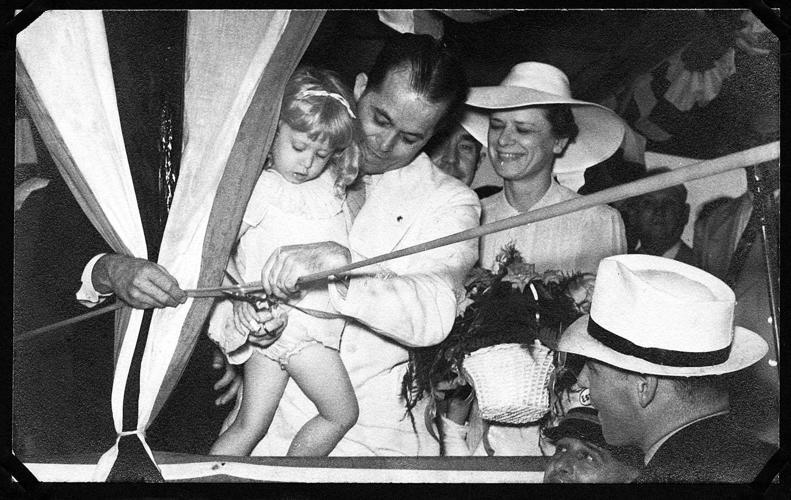
Sam Houston Jones was born on July 15, 1897, in Merryville, Louisiana—a small town near DeRidder along the Texas-Louisiana border in Beauregard Parish. He graduated from DeRidder High School in 1915, as the valedictorian and class president. He studied at Louisiana State University (LSU) in Baton Rouge for two years but enlisted in the United States Army before receiving his graduation diploma. It is unknown if or when Jones completed an undergraduate degree, however, he excelled in the Army Reserve Officers Corps during World War I, a global conflict which lasted from 1914 to 1918. He entered the infantry, while spending most of his service at a nearby base, named Camp Beauregard, in Pineville, Louisiana.
After World War I, Jones returned to Baton Rouge, Louisiana and attended law school at LSU in 1919. Before graduating, Jones became involved and interested in local politics, serving as a delegate at the Louisiana Constitutional Convention of 1921. Jones was one of the 128,000 voting delegates which approved the new constitution. Within a year, Jones obtained a license to practice law in 1922; he took night classes to finish law school while working as a clerk of court during the day. He practiced law in DeRidder until 1924 when he moved to the city of Lake Charles, Louisiana. In Lake Charles, Jones practiced law before rising to district attorney of Calcasieu Parish in the 14th Judicial District, where he served from 1925 to 1934.
By August 1939, Jones had established quite the reputation as a rising politician. He was approached by the opposition of Huey P. Long Jr., who was Louisiana’s governor from 1928 to 1932 then a U.S. Senator from 1932 to 1935 when he was assassinated. Long changed Louisiana Politics through left-wing populist ideas of social reform from voting and educational improvements and economic wealth redistribution through state-funded taxes and tariffs. No other Louisiana governor had the same effect on Louisiana, creating the idea of a “Long dynasty” with several of Long’s relatives riding his coattails into political office. For this reason, anti-Long supporters wanted Jones to run for governor against Long’s brother, Earl, in 1940. Jones was hesitant to agree, knowing the power that the Longs held. Jones’s platform focused on honesty and honed in on the scandals and corruption of the Long years. They even compared Earl’s potential time in office to the previous Governor Richard Leche, Huey Long’s Successor who was convicted and imprisoned for misusing federal funds. Earl Long was Leche’s lieutenant governor from 1936 to 1939. While Earl held the lead vote during majority of the primary race, his reign splintered on the support of James Noe—the third gubernatorial candidate who was a former supporter of the Long family but supported Jones in the end. Jones won the runoff election in 1940, marking the end of the Long’s 12-year hold of the Louisiana governor’s office. On May 14, 1940, Jones was elected governor by popularity.
During his time in state office, Jones is most known for creating civil service legislation that restructured the government into a civil service system, with reductions to state agencies and state employment. While cutting some employment opportunities, he also raised the pay of teacher’s salaries and continued to raise the Long economic welfare programs, like free lunches for school children, equal pay among race for educators, and surpass funding for state and public colleges. Without name-recognition or politicking, Jones restored Louisiana’s image of an honest and respectful government. Jones called for fair, honest elections with the elimination of annual voter registration. He also implemented the voting machine system and pioneered a bidding system for state contracts and purchases to ensure anti-fraud.
At the same time that his political career was taking off, Jones’s family life was in full swing. He married a woman from DeRidder named Louise Gambrell Boyer in 1925. Boyer was a supportive wife and governmental ambassador. She was once introduced as the “Governor of the Governor of Louisiana” at a delegate dinner at the American Embassy in Mexico City in 1941. Jones and Boyer had four children, two during their marriage—Carolyn and Robert “Bobby” Jones—and two children who were adopted from Boyer’s previous marriage—James “Jimmy” and William “Bill” Boyer.
Jones did not seek an immediate second term. At the time, Louisiana’s constitution prohibited the secession of the incumbent governor after his term to avoid a hold on the seat. Therefore, Jones continued in office until May 9, 1944, when he was replaced by country music singer Jimmie Davis. Davis’s popular song “You Are My Sunshine” skyrocketed into popularity during Jones’s administration in 1940. Jones left Davis’s administration with a reduced debt and a substantial, $15 million-dollar, state treasury surplus—the first to do so in the last forty years. Jones was so financially responsible with monetary consolidation, that he would later serve on intergovernmental relations committees for commerce and research in the 1950s. Jones attempted another gubernatorial run in 1948, against Earl Long again, but lost. Historians claim that Long was able to “out promise” Jones on his campaign run. The Long name would hold the office seat again on May 11, 1948. Jones would never seek a second run for governor again.
Jones returned to Lake Charles in the early 1940s, after his brief time in higher office. He raised his family there for the next 40 years. Jones passed away on February 8, 1978. He is buried in Lake Charles at the Prien Memorial Park Cemetery.
The same year as his death in 1978, The Louisiana Senate passed a measure to rename the Sam Houston State Park near Lake Charles, in Moss Bluff, Louisiana. The park was originally named for Sam Houston, a Texas statesmen known as a pioneer of the Texas Revolution. Houston enjoyed traveling extensively to regions of west Louisiana—including Lake Charles. A high school of the same name is recognized down the street of the Louisiana state park. In 1934, Louisiana passed legislation to establish a state park system named the State Parks Commission of Louisiana. After its formation, seven sites were acquisitioned for public use, as state parks. With World War II in full effect and recreation funds on the decline, a new park development was declined for one new park site—Sam Houston State Park. However, by 1944, Sam Houston State Park received its official title and public opening. Jones, as acting governor, fought tirelessly for the land, in hopes to create the first and only state park in Southwest Louisiana. He was the driving force behind its designation. Since 1978, the park has honored his efforts for the land.
In addition to the park, Jones was honored in 1987 with a memorial highway in his name. The highway named the Sam Houston Jones Parkway was the first dedication by Governor Charles “Buddy” Roemer on July 11, 1988. Other politicians, like Senator Bill McLeod of Lake Charles, Representative Vic Stelly of Moss Bluff, and the President of the Calcasieu Parish Police Jury, Don Manuel all helped honor Jones. McLeod began brainstorming the highway expansion project of Louisiana highway 378 (LA 378) sixteen years prior. He knew that Jones was a fit honoree for the highway due to his contributions to the Lake Charles area and the state of Louisiana. The highway, a three-mile portion of LA 378 officially named after Jones, leads to the state park named after him—Sam Houston Jones State Park.
For more (including 9 images & 1 audio file) view the original article
]]>