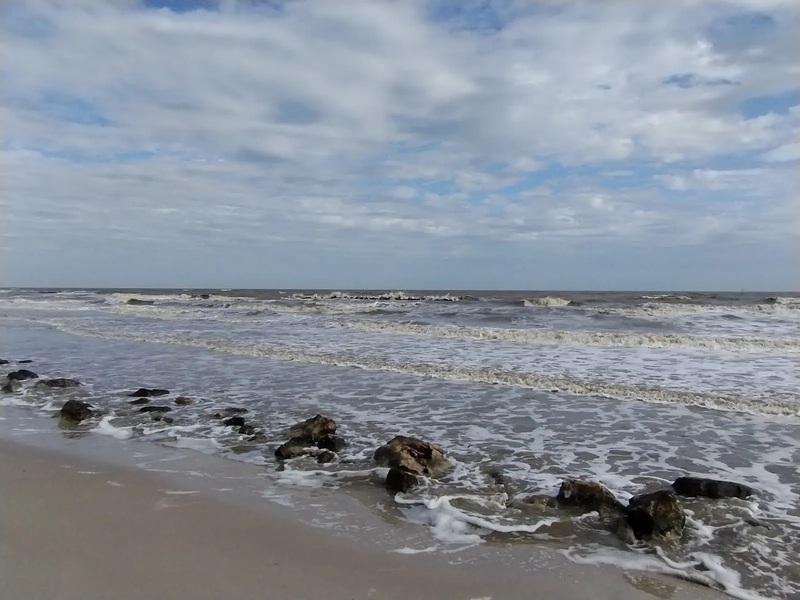
Rodney John Guilbeaux, Jr. was born on Dec 18, 1926, in Kaplan, Louisiana. On his eighteenth birthday in 1944, Guilbeaux entered the military and served as a junior-grade lieutenant in the U.S. Marines. Upon returning from war, Guilbeaux settled in New Orleans, Louisiana, but by the early 1950s, he decided to move back west to the area he grew up in. He is noted as saying, "Some people like the lakes, some people like the rivers. I was a beach bum” to Fox News. So, Guilbeaux bought a camp in the newly developed, Constance Beach. The village is south of LA 82 and seven miles west of Holly Beach—Louisiana’s most famous beach, where the Rodney Guilbeaux Memorial Sign is located. He lived there on the weekends and worked in Sulphur, Louisiana as an advertising manager for Wise Publications, a Printing and Bookstore in Southwest Louisiana. In 1961, Guilbeaux purchased property along LA 82 in Cameron Parish. He bought and opened the Gulf Coast Store in Holly Beach, Louisiana. Owning and operating a family business was not a new quest for Guilbeaux. His dad, Rodney John Guilbeaux, Sr., owned not one but two influential storefronts in Cameron Parish. Guilbeaux Sr. owned Guilbeaux's Dry Cleaners and Laundry in Cameron, Louisiana prior to the 1950s. He was quite successful as “Cameron’s only cleaning and pressing shop,” taking out ads regularly in the local newspaper, the Cameron Parish Pilot. One of the last ads for Guilbeaux's Dry Cleaners and Laundry was on August 8th, 1957, after Hurricane Audrey. The ad stated “Rodney Guilbeaux, owner of Guilbeaux's Laundry & Cleaners, announces that he and his son, Guilbeaux Jr., will be at the shop this Sunday between 10 a.m. and 3 p.m. to return all clothing that was in the shop at the time of the storm.” However, as a successful businessman, no one was surprised when the Cameron Parish Pilot announced in a full-page spread that the “Cameron Shell Service Station was now under new management”— Guilbeaux Sr. in 1962, five years after the devastating storm.
Guilbeaux followed in his father’s footsteps as an active community leader and businessman. In 1964, Guilbeaux was the publicity chairmen for the Southwest District Fat Stock Show and Rodeo in Lake Charles at the McNeese State University coliseum. He was a fan of McNeese State University, becoming their athletic radio announcer. Guilbeaux was particularly fond of their basketball team and was ecstatic when they made it to the Sweet 16 Tournament in 1968. Guilbeaux has an archival collection at McNeese State University’s Frazer Memorial Library to commemorate his time there. He also coached youth girls’ softball for the St. Charles Academy and the Veterans of Foreign Wars’ youth baseball in Sulphur. His dedication to youth recreation and sports was solidified in the 1990s, when he was inducted into the Wall of Honor for Sulphur Parks and Recreation (SPAR). Guilbeaux cared for every community member regardless of age. He was active in numerous community service organization, including International Order of Alhambra and Louisiana Lions League. However, Guilbeaux took some of his humanitarian work relatively more seriously than others, like Southwest Louisiana Safety Engineering Society, Calcasieu Area Safety Council, West Cameron Port Commission, and the Environmental Development Task Force in Louisiana.
Guilbeaux cared deeply about the environment, coastal erosion, and weather safety due to growing up along the Gulf Coast of Mexico. He began to take action towards preserving the coastline in his retirement years when his beachfront home slowly started eroding. Guilbeaux recalled that his property on Richard Lane, used to have four streets between his camp and the Gulf of Mexico—250 feet of beach. However, by the 1990s, Guilbeaux’s property was touching the Gulf. To combat water erosion, Guilbeaux continued to buy properties, one after another when the water engulfed them. Guilbeaux and his wife, Mickey, had acquired so much land that locals referred to their property as the “Constance Beach Hilton.” They paid taxes on all of the land, even though most of it was underwater, in hopes that the land would reemerge from the Gulf. Guilbeaux turned towards activism and advocacy efforts in hopes to keep the coastline in Cameron Parish. Guilbeaux recalled in a Fox News interview that the government did not want to help, but once the Army Corps of Engineers realized that “I was [not] just trying to protect my house [, but I was] trying to protect the whole marsh because we were the last ridge, the last high spot between the Gulf and the marshes,” they began to listen. LA 82 was the anchor between the Gulf Coast and the Sabine National Wildlife Refuge’s marsh—home to Louisiana specific and protected animals, like Alligators, egrets, and the brown pelican. Guilbeaux did such a good job at advocating for Cameron Parish’s coastline that he was able to convince a U.S. Senator from Louisiana, John Breaux, to join his fight. Breaux sponsored the Coastal Wetlands Planning, Protection and Restoration Act of 1990. At Guilbeaux’s request, the Coastal Wetlands’ task force was able to fund sand filling along the beach and breakwater systems along Cameron Parish’s shoreline on LA 82. Engineers began to request Guilbeaux’s consultation on restoration projects. Locals referred to him as “the mayor” of the area of Constance Beach, even the Louisiana Governor visited him there.
Guilbeaux was a pioneer member of the Coalition to Restore Coastal Louisiana (CRCL), founded in 1988. In the 1990s, the CRCL worked on a diverse range of restoration activities, and Coastal Wetlands Planning, Protection, and Restoration Act (CWPPRA), signed into law in 1990, provided funding for coastal restoration projects. By 1998, Guilbeaux received a Coastal Stewardship Award for his dedication to promoting Cameron parish and erosion-prevention. A year prior in 1997, Guilbeaux won the Citizen of the Year award for Cameron Parish. By 1999, Guilbeaux was a prominent figure in the fight for coastal preservation on a governmental level. He served as the Cameron Parish Representative on the Louisiana Coastal Wetlands Conservation and Restoration Task Force and Wetlands Conservation and Restoration Authority. Guilbeaux helped to create a “plan to address Louisiana’s massive coastal land loss problem and provide for a sustainable coastal ecosystem by the year 2025.” One of their worries for Cameron Parish was hurricane damage effects on its fragile coast. The state of Louisiana loses around 35 miles per year to coastal erosion. After Hurricane Isidore, which washed away miles of beach and endangered wildlife near Holly Beach in 2002, Guilbeaux authored the 7-mile Holly Beach restoration project. Guilbeaux insisted the community and government should take action before "[t]here [was] […] nothing left of my beach.” In 2003, Guilbeaux saw the Holly Beach/ Constance Beach Restoration Project, the largest shoreline protection built according to the Natural Resources Conservation Service (NRCS) and the Department of Energy and Natural Resources (DNR), to completion. It cost a whopping $30 million dollars and protected 300,000 acres of coastline. The project built and packed the sand up on the coastline by five feet, allowing for the waves to crash further out in the Gulf coast rather than against LA 82. LA 82 is a state highway that runs horizontal along the most southern part of Louisiana; it is 143 miles, ranging from the Texas state line in the East to the Vermillion-Lafayette parish line in the West, where it turns into United States Highway 90. LA 82 is vital to the region serving as a connection from small coastal communities to major port distributors in Port Arthur, Abbeville, and Lake Charles via LA 27—servicing the region’s oil, gas, and seafood industries. The road, although prone to flooding and hurricane damage, is a crucial route for the area. This action of adding five feet of sand to the coast would help preserve the land in South Cameron Parish for longer, conserving homes and roads. Those who worked with Guilbeaux on the project described him as an “advocate, ambassador, and pest in the best sense of the word.”
Flooding and storm surges have a long history in Cameron Parish. Hurricanes were so frequent along the Louisiana coastline that Guilbeaux became a regular “Weather Watcher” for Constance Beach on KPLC News Channel 7. On September 24, 2005, Guilbeaux watched as a category 3 hurricane named Rita made landfall, with 110 miles per hour winds and peak gusts of 150 miles per hour according to the National Weather Service, on Johnson Bayou, a little under five miles from his home on Constance Beach. All of the inhabited houses surrounding Holly Beach, including Guilbeaux’s camp, were destroyed or disappeared when the storm began to turn inward to the East. By the next morning, Guilbeaux decided that he would not rebuild the next day, as he could not physically endure the carpentry since losing his leg to diabetes in the year prior, 2004. Guilbeaux died two years later, at the age of 80, on Thursday, September 20, 2007, in Lake Charles, Louisiana.
Guilbeaux’s legacy still lives on today. In 2020, a monumental, category-four hurricane named Laura hit Cameron Parish in the early morning hours of August 27. Hurricane Laura made history as the 10th strongest hurricane to make landfall in the United States, causing damage across the entire state of Louisiana. Without their storm watcher Rodney in the area, KPLC News anchor, Cynthia, retold the story of Rodney Guilbeaux’s life during Hurricane Audrey, as Hurricane Laura brought back similar memories. Cynthia says “I’m really gonna take you back with this one [story]” to June 27, 1957. Hurricane Audrey made landfall near the Texas-Louisiana Border in Cameron Parish. Audrey was the first major hurricane since 1945 and quickly became one of the deadliest. Hurricane Audrey killed at least 416 people—including nine members of Guilbeaux's family. Cynthia recalls the Guilbeaux’s tragic survival story of hurricane, with “his finger going through water” when he woke up in the middle of the night. Guilbeaux thought “he was dreaming” until he woke up and “his bed was floating in the middle of the water.” Guilbeaux lost his mother that night in 1957. She drowned in the flood water and her body was recovered miles away 15 days after the storm settled. This event would serve as the catalyst for Guilbeaux’s interest in watching the weather and protecting the coastline in Cameron Parish. Today, coastal conservationists still work along the Cameron Parish coast to preserve Guilbeaux’s life effort.
For more (including 15 images & 1 audio file) view the original article
]]>