<?xml version="1.0" encoding="UTF-8"?>
<feed xmlns="http://www.w3.org/2005/Atom">
  <title type="text">Acadiana Historical</title>
  <updated>2026-03-04T22:42:50+00:00</updated>
  <generator uri="http://framework.zend.com" version="1.12.20">Zend_Feed_Writer</generator>
  <link rel="alternate" type="text/html" href="https://acadianahistorical.org/"/>
  <link rel="self" type="application/atom+xml" href="https://acadianahistorical.org/items/browse?output=rss2"/>
  <id>https://acadianahistorical.org/</id>
  <author>
    <name>Acadiana Historical</name>
    <uri>https://acadianahistorical.org</uri>
  </author>
  <link rel="hub" href="https://pubsubhubbub.appspot.com/"/>
  <entry>
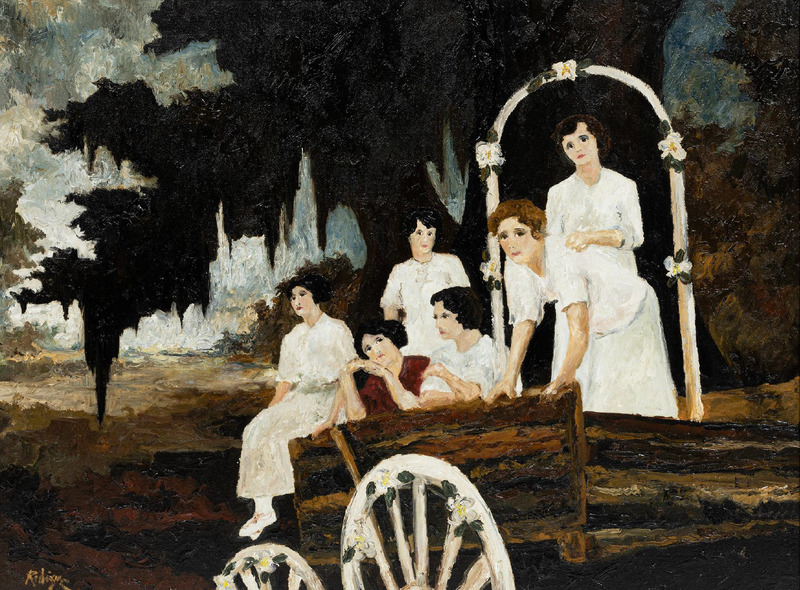
    <title type="html"><![CDATA[Blue Dogs and Bayous: The George Rodrigue Memorial Overpass: US Highway 90 and LA Highway 83 Intersection]]></title>
    <summary type="html"><![CDATA[<p><strong><em>Louisiana Memorial Highway no. 135 is known as the George Rodrigue Memorial Overpass. The overpass located at the intersection of U.S. Highway 90 and Louisiana Highway 83, just north of the outskirts of New Iberia, Rodrigue’s hometown. It was passed as House Bill no. 402 and designated August of 2014. </em></strong></p><img src="https://acadianahistorical.org/files/fullsize/1bbf98f354db8d664207525bcc12b49e.jpg" alt="&quot;Queen of the Rice Festival, Crowley, LA&quot; " /><br/><p>George Rodrigue was born March 13th, 1944, in New Iberia, Louisiana to French Creole and Cajun parents. He was diagnosed with polio in third grade and began painting while bedridden for a few months, with his first painting being a “paint by numbers” canvas that he painted over to make his own. Rodrigue fully recovered from polio, but his love for art remained. In 1962, he began taking art classes at the University of Southwestern Louisiana (later UL) and ended up on the West Coast at the ArtCenter College of Design in California. By 1968, he had graduated, and returned home to Louisiana, stating, “I grew up feeling a strong relationship to the old things, to the old culture, and I got a stronger feeling when I went to Los Angeles to school. I really started to understand how different I was and how different my Louisiana was." </p><p>      His paintings took on two very unique aesthetics. The first is his depiction of the Southwest Louisiana landscape and the Acadian/Cajun people. This artwork is categorized by a dark and moody scene, with bayous, live oak trees, Spanish moss, and Creole/Cajun houses. The focal points of these paintings are the Cajun people, who are often in bright white clothing and are pale with dark hair. Arguably the most recognizable symbol of his work, the Blue Dog, was created in the early 1980s. While working on paintings for the book Bayou, a collection of ghost stories and folklore, Rodrigue sought to depict the Cajun werewolf called the <em>loupgarou</em> or <em>rougarou</em>. His muse was his dog, Tiffany. She was a hybrid of both his past and future art, painted blue with yellow eyes, in front of a surreal bright red Creole house among a South Louisiana live oak. Rodrigue’s art began to shift in the 2000s, where he used bright vibrant colors, abstract shapes and lines, and surreal motifs to depict the Blue Dog.</p><p>      Rodrigue was commissioned for several pieces over the years. <span class="NormalTextRun SCXW46362454 BCX0">Harkening back to his childhood experience with hospitals, Rodrigue created a series of Blue Dog paintings on </span><span class="NormalTextRun SCXW46362454 BCX0">material commonly found in hospitals. The art is displayed in hospitals across Tennessee, Texas, and Louisiana, in </span><span class="NormalTextRun SCXW46362454 BCX0">hopes</span><span class="NormalTextRun SCXW46362454 BCX0"> of </span><span class="NormalTextRun SCXW46362454 BCX0">making it all seem less scary. <span class="NormalTextRun SCXW223316176 BCX0">He also worked with Absolut Vodka and Xerox to create </span><span class="NormalTextRun ContextualSpellingAndGrammarErrorV2Themed SCXW223316176 BCX0">advertisements. </p><p>      <span class="NormalTextRun SCXW106028086 BCX0">In the 2000s, Rodrigue devoted his time to </span><span class="NormalTextRun SCXW106028086 BCX0">helping his country, as well as his Louisiana neighbors.</span><span class="NormalTextRun SCXW106028086 BCX0"> He </span><span class="NormalTextRun SCXW106028086 BCX0">advocated for relief for the victims of 9/11 and Hurricane Katrina.</span><span class="NormalTextRun SCXW106028086 BCX0"> After the hurricane, Rodrigue had to </span><span class="NormalTextRun SCXW106028086 BCX0">relocate</span><span class="NormalTextRun SCXW106028086 BCX0"> to Lafayette from New Orleans and </span><span class="NormalTextRun SCXW106028086 BCX0">immediately</span><span class="NormalTextRun SCXW106028086 BCX0"> began </span><span class="NormalTextRun SCXW106028086 BCX0">creating art to support the New Orleans Museum of Art that was closed due to flood damage. <span class="TextRun SCXW106028086 BCX0">He raised over $700,000 for the Musem.</span></p><p>       In 2009, Rodrigue’s passion for education led him to establish the George Rodrigue Foundation of the Arts that “advocates the importance of the arts in the development of our youth. GRFA encourages the use of art within all curriculums and supports a variety of art educational programs.” As of 2024, the program has awarded 7,200 students with $630,000 in scholarships for their artwork and songwriting. A secondary program, George’s Art Closet, donates art supplies to schools across the state. </p><p>      <span class="TextRun SCXW36005609 BCX0"><span class="NormalTextRun SCXW36005609 BCX0">In 2012, Rodrigue was diagnosed with stage four lung cancer. He believed that this might have been caused by </span><span class="NormalTextRun SCXW36005609 BCX0">unsafe painting practices in his early career, like spraying </span><span class="NormalTextRun SCXW36005609 BCX0">toxic</span><span class="NormalTextRun SCXW36005609 BCX0"> varnish in his unventilated studio. He passed away on December 14, </span><span class="NormalTextRun SCXW36005609 BCX0">2013,</span><span class="NormalTextRun SCXW36005609 BCX0"> in Houston and a burial mass was held in New Orleans for him. Rodrigue’s legacy </span><span class="NormalTextRun SCXW36005609 BCX0">as a brilliant artist and humanitarian </span><span class="NormalTextRun SCXW36005609 BCX0">will live on</span><span class="NormalTextRun SCXW36005609 BCX0">. <span class="TextRun SCXW216714026 BCX0"><span class="NormalTextRun SCXW216714026 BCX0">Many</span><span class="NormalTextRun SCXW216714026 BCX0"> Louisiana</span><span class="NormalTextRun SCXW216714026 BCX0"> residents and tourists have fond memories of visiting Rodrigue’s galleries in New Orleans and Lafayette that are </span><span class="NormalTextRun SCXW216714026 BCX0">maintained</span><span class="NormalTextRun SCXW216714026 BCX0"> by his sons, </span><span class="NormalTextRun SCXW216714026 BCX0">Andre</span><span class="NormalTextRun SCXW216714026 BCX0"> and Jacques. </span><span class="NormalTextRun SCXW216714026 BCX0">And after twenty years, the Rodrigue themed Cajun/Creole restaurant, the Blue Dog Cafe, closed its doors due to the COVID-19 pandemic.</span><span class="NormalTextRun SCXW216714026 BCX0"> Museums display his paintings and towns display sculptures of the Blue Dog. There is a park in New Iberia dedicated to Rodrigue.</span></span><span class="EOP SCXW216714026 BCX0"> </p><p>      <span class="NormalTextRun SCXW219237455 BCX0">The George Rodrigue Memorial Overpass </span><span class="NormalTextRun SCXW219237455 BCX0">was officially proposed by Representative Taylor Barras and received a unanimous vote. </span><span class="NormalTextRun SCXW219237455 BCX0">The Department of </span><span class="NormalTextRun SCXW219237455 BCX0">Transportation</span><span class="NormalTextRun SCXW219237455 BCX0"> installed a memorial </span><span class="NormalTextRun SCXW219237455 BCX0">plaque</span><span class="NormalTextRun SCXW219237455 BCX0"> at the site of</span><span class="NormalTextRun SCXW219237455 BCX0"> the location.</span></span></span></span></span></span></span></p><p><em><strong><a href="https://acadianahistorical.org/items/show/247">For more (including 16 images&#32;&amp;&#32;1 audio file) view the original article</a></strong></em></p>]]></summary>
    <published>2025-02-14T02:44:09+00:00</published>
    <updated>2026-03-04T22:42:50+00:00</updated>
    <link rel="alternate" type="text/html" href="https://acadianahistorical.org/items/show/247"/>
    <id>https://acadianahistorical.org/items/show/247</id>
    <author>
      <name>Kallie R. Barron</name>
    </author>
  </entry>
  <entry>
    <title type="html"><![CDATA[Against The Grain: The Endurance Of The Conrad Rice Mill: The 112-year-old Conrad Rice Mill is the oldest operating rice mill in America. ]]></title>
    <summary type="html"><![CDATA[<p><strong><em>The Conrad Rice Mill is a story of success and resilience, steered by competent and astute businessmen from Philip Conrad to Mike Davis.</em></strong></p><img src="https://acadianahistorical.org/files/fullsize/a12caeca25911578813211e87fd4bf1f.jpg" alt="Conrad Rice Mill When Purchased" /><br/><p>Philip Amalus Conrad, a true entrepreneur, founded the Conrad Rice Mill and Planting Company in 1912. Following in his father's footsteps as a rice planter, Philip saw an opportunity for growth. Instead of shipping his rice to New Orleans, a risky and time-consuming process, he decided to establish a mill on his property in New Iberia. As the company flourished, the mill began sourcing grain from other rice growers to meet consumer demand. </p><p>At the age of retirement, Philip passed on his hard work to his three sons. The brothers branded the company KONRIKO as an acronym for Conrad Rice Company in the 1950s. In 1975, Mike Davis bought the mill and brought it back to life after it had been dormant for two years. Davis was a schoolteacher for St. Martin and Iberia Parishes. One of the biggest obstacles for Davis was having to learn how to produce rice. He had to analyze why the mill had been sitting dormant and needed to execute a plan to get it running again. He also had to figure out how to pack the milled rice; after packaging the rice, he went store to the store to ask them to sell the product. </p><p>When Davis took over the mill, they started by simply selling white rice, but as time moved on, he transitioned the mill to creating specialty rice. KONRIKO also expanded into selling cooking mixes and seasonings: Greek, Creole, jalapeno, etc. The brand also created a gravy thickener using rice starch instead of corn starch. KONRIKO's signature product is wild pecan rice; it was the first product Davis released about two years after purchasing the mill. </p><p>In the 1980s, Davis applied to the National Historical Register. It helped to create a tourist attraction. Now, the Conrad Rice Mill is a must-see in New Iberia, although ironically, half of the city has yet to see it. Roughly 50,000 people visit the mill annually. Davis also built a general store in 1981. It is modeled after a plantation company store. KONRIKO offers tours of the mill and a slide show presentation. In total, KONRIKO covers about 5 – 6 acres in New Iberia. The oldest building was built in 1912, and the newest building, a warehouse, was built by Davis in the late 1980s and early '90s.</p><p>Today, the Conrad Rice Mill continues to thrive, producing rice and rice-based products nationwide. This is a testament to the ingenuity and perseverance of those who have worked to keep the mill running for over a century.</p><p><em><strong><a href="https://acadianahistorical.org/items/show/230">For more (including 19 images&#32;&amp;&#32;1 audio file) view the original article</a></strong></em></p>]]></summary>
    <published>2024-04-19T03:09:37+00:00</published>
    <updated>2026-03-04T22:42:50+00:00</updated>
    <link rel="alternate" type="text/html" href="https://acadianahistorical.org/items/show/230"/>
    <id>https://acadianahistorical.org/items/show/230</id>
    <author>
      <name>Marie Hamilton</name>
    </author>
  </entry>
  <entry>
    <title type="html"><![CDATA[Greig&#039;s West Main Grocery: Greig&#039;s little store was a gatekeeper of the growing city of New Iberia for nearly 50 years.]]></title>
    <summary type="html"><![CDATA[<p><strong><em>The buzzer sounded on the kitchen door, notifying Raymond August Greig that someone had entered his store. The kitchen door opened into the small, connected building on West Main Street in New Iberia. Raymond would meander behind the counter, greet his guest, sit in his worn yellow chair, and welcome a new business day. Greig's West Main Grocery was your average small corner store that supported patrons heading in and out of town on Highway 182.</em></strong></p><img src="https://acadianahistorical.org/files/fullsize/2afebdec2a2a18638cff05ab2a603f6d.jpg" alt="Raymond holding his grandkids in his West Main grocery store." /><br/><p>Raymond August Greig was born in St. Martinville, Louisiana, on November 28, 1914. Raymond was a bright boy but never received more than an 8th-grade education. Ray met Carrie Leigh Broussard at a county fair. They wed on November 30, 1935, before moving to Texas, where Raymond worked for the Southern Pacific Railroad. They moved all over Texas following the growth of the railroad. Raymond was indispensable to the railroad: he was unafraid of heights and skilled at his job; this allowed him to escape the draft into World War 2. The family returned to Louisiana in 1941 and eventually made their home in New Iberia, on 1200 West Main Street. Raymond built the property and store in the 1940s. There, they raised their three kids; their grandkids would also spend much of their childhood at the store and home. </p><p>Attached to their private residence, Greig's Grocery was a hotspot for cola, cigarettes, and cold beer. The front door opened to a small space; on either side of the door were two large windows. The store was small, boasting 1-2 isles in the middle and a long counter holding a large old-time cash register with a satisfying cha-ching when he pulled the lever. Below the register, Raymond kept track of purchases in a flip book, even opening tabs for regular customers. </p><p>Behind the long counter on the right side of the store was a wall of candy boasting all the latest brands: Snickers, Milky Way, M&M's, etc. Cigarettes and toothpaste were also waiting on the shelves for the desiring customer. The long counter held a deli with fresh meat and cheese to be sliced in the grocery's deli slicer. Raymond had chickens in the backyard; he pickled the eggs and sold them in the store. At the end of the counter were shelves holding packages of baked goods, not only bread but packaged Little Debbie treats. Various dried goods were on the far wall across from the long checkout counter. A big Coca-Cola icebox stood by the front door.</p><p>Greig's West Main Grocery served customers for nearly 50 years. Carrie Leigh passed away in 1995. Shortly after her death, the store was robbed. The offenders attacked Raymond and sprayed him with pepper spray. The store was closed and put up for sale by 1997.  The property was sold and became May's Oriental Grocery. Raymond August's middle son had a small wooden cabin built for his father to live in for the remainder of his life, where Raymond resided until his passing on February 27, 2000. Raymond is buried beside his wife at the Nativity Mausoleum in New Iberia.</p><p><em><strong><a href="https://acadianahistorical.org/items/show/198">For more (including 9 images&#32;&amp;&#32;1 audio file) view the original article</a></strong></em></p>]]></summary>
    <published>2024-03-16T19:03:11+00:00</published>
    <updated>2026-03-04T22:42:49+00:00</updated>
    <link rel="alternate" type="text/html" href="https://acadianahistorical.org/items/show/198"/>
    <id>https://acadianahistorical.org/items/show/198</id>
    <author>
      <name>Marie Hamilton</name>
    </author>
  </entry>
</feed>
