Site 10: Fort Proctor — The Screwmen's Guard: The Screwmen and the Civil War
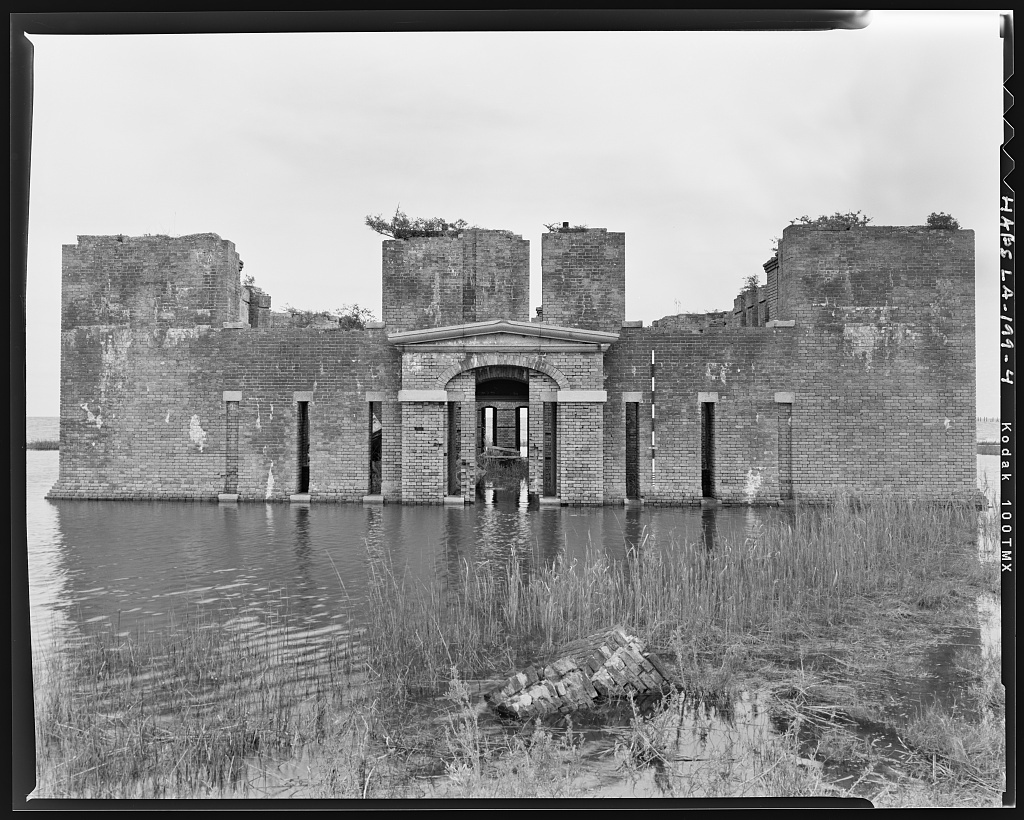
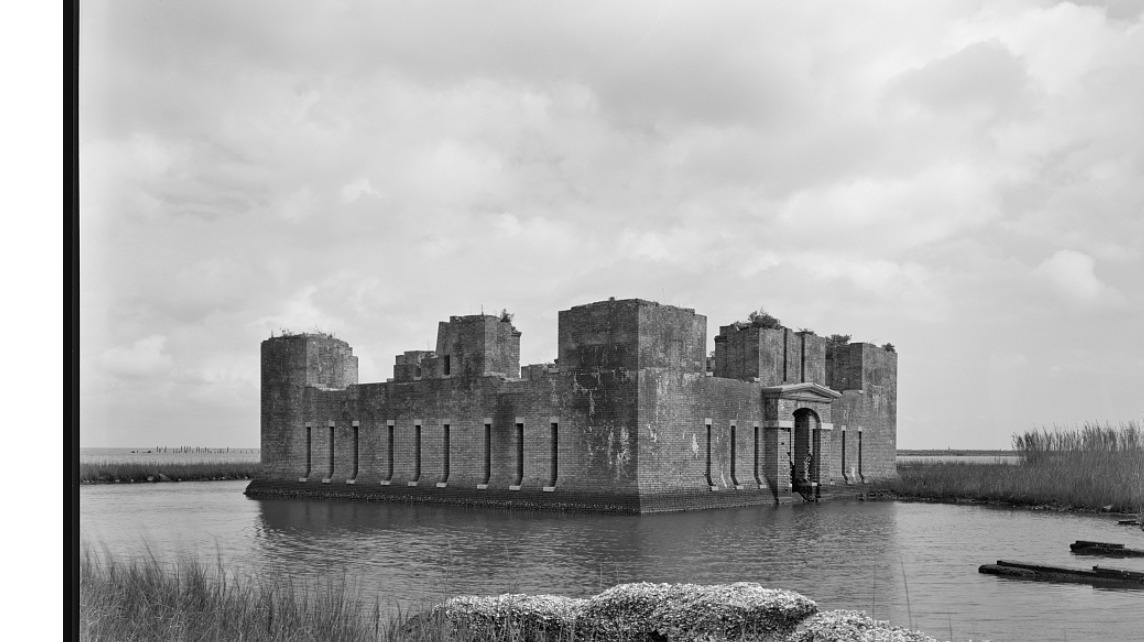
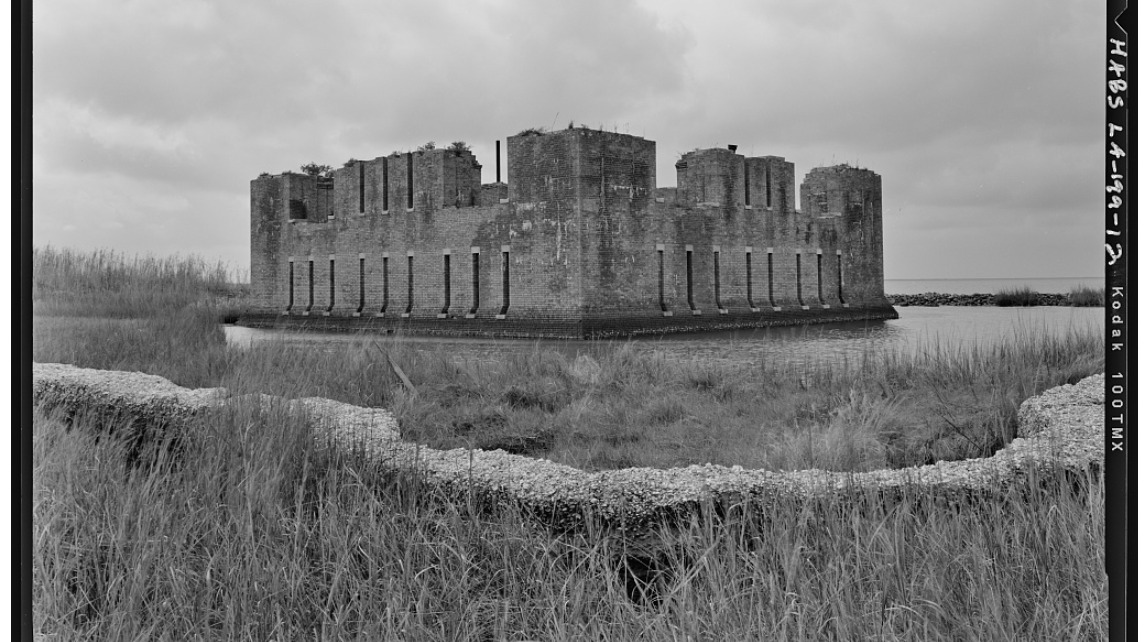
Fort Proctor looms on the horizon, like a castle rising from the choppy waters of Lake Borgne.
Text
Irish immigrant and prominent screwman, Samuel Risk, established the Screwmen’s Guard, a battalion of roughly 600 members of the Screwmen’s Benevolent Association. They offered their services to the Confederate cause, willing to fight against a “sectional Administration [who] coerce[s] a free people to submit to their bigoted and fanatical designs, against the fundamental principles of the Constitution for which our forefathers fought and conquered, [making] it the imperative duty of every true Southerner to stand shoulder to shoulder, in a solid phalanx of determined opposition to such despotic domination." While modern historians and observers may take offense at this histroically situated assessment of the situation, what is not questioned is that the Screwmen’s Guard grew to a full regiment during the Civil War.
During the Civil War, members of the Screwmen's Guard entered Confederate military service. Under Captain Isaac W. Patton, the company helped man artillery defenses below New Orleans during the Union naval assault of April 1862 and became part of the wider Confederate war effort. However, military service came at a cost to the screwmen's labor organization. Enlistments depleted its membership and nearly brought the Screwmen's Benevolent Association to an end. Following the war, the surviving organization rebuilt its influence along the New Orleans waterfront. It was here at Fort Proctor that the Screwmen's Guard initially mustered and then moved forward to fulfil the military commands that dicated their Civil War service to the Confederacy.
The Army Corps of Engineers built the fort on the southern shore of Lake Borgne, located in Saint Bernard Parish. Confederate commanders recognized that the road that ran along the shore, as well as Bayou Terre aux Boeufs both provided easy access to New Orleans. It was therefore a potential invasion point for Union forces.
The fort is two-story, Renaissance-style building with walls approximately four feet thick. It has a square floor plan. Originally, four main guns were mounted on a parapeted roof terrace. The first floor has a central entrance on the east side which soldiers could only reach by a drawbridge. The architects considered the comfort of those stationed there, building vertical slits in the outside walls for light, as well as a complete plumbing system for the bathrooms. A letter written by the association’s president and Confederate leader, Samuel Risk, describes a “stiff nor ’wester” that blew through the fort in September 1861.
The only way to access Fort Proctor is by water. I rented a kayak from an outfitter in New Orleans and paddled out the fort on a cold and windy February day. Choppy water and high winds almost forced me to turn back, but I decided to forge ahead. It was thrilling to see the 172-year-old fort rise out of the water as we rounded a bend in the canal.
The waters from Lake Borgne engulfed much of Fort Proctor. Any ground that was visible consisted of feet of thick mud. As I picked my way from brick to brick and entered the fort, I could not help but feel the excitement of a new day meeting old history. The only sounds were those of waves splashing against the brick. The solitude helped facilitate an intimate connection with people from the past.