Blue Dogs and Bayous: The George Rodrigue Memorial Overpass: US Highway 90 and LA Highway 83 Intersection
Louisiana Memorial Highway no. 135 is known as the George Rodrigue Memorial Overpass. The overpass located at the intersection of U.S. Highway 90 and Louisiana Highway 83, just north of the outskirts of New Iberia, Rodrigue’s hometown. It was passed as House Bill no. 402 and designated August of 2014.
Text
George Rodrigue was born March 13th, 1944, in New Iberia, Louisiana to French Creole and Cajun parents. He was diagnosed with polio in third grade and began painting while bedridden for a few months, with his first painting being a “paint by numbers” canvas that he painted over to make his own. Rodrigue fully recovered from polio, but his love for art remained. In 1962, he began taking art classes at the University of Southwestern Louisiana (later UL) and ended up on the West Coast at the ArtCenter College of Design in California. By 1968, he had graduated, and returned home to Louisiana, stating, “I grew up feeling a strong relationship to the old things, to the old culture, and I got a stronger feeling when I went to Los Angeles to school. I really started to understand how different I was and how different my Louisiana was."
His paintings took on two very unique aesthetics. The first is his depiction of the Southwest Louisiana landscape and the Acadian/Cajun people. This artwork is categorized by a dark and moody scene, with bayous, live oak trees, Spanish moss, and Creole/Cajun houses. The focal points of these paintings are the Cajun people, who are often in bright white clothing and are pale with dark hair. Arguably the most recognizable symbol of his work, the Blue Dog, was created in the early 1980s. While working on paintings for the book Bayou, a collection of ghost stories and folklore, Rodrigue sought to depict the Cajun werewolf called the loupgarou or rougarou. His muse was his dog, Tiffany. She was a hybrid of both his past and future art, painted blue with yellow eyes, in front of a surreal bright red Creole house among a South Louisiana live oak. Rodrigue’s art began to shift in the 2000s, where he used bright vibrant colors, abstract shapes and lines, and surreal motifs to depict the Blue Dog.
Rodrigue was commissioned for several pieces over the years. Harkening back to his childhood experience with hospitals, Rodrigue created a series of Blue Dog paintings on material commonly found in hospitals. The art is displayed in hospitals across Tennessee, Texas, and Louisiana, in hopes of making it all seem less scary. He also worked with Absolut Vodka and Xerox to create advertisements.
In the 2000s, Rodrigue devoted his time to helping his country, as well as his Louisiana neighbors. He advocated for relief for the victims of 9/11 and Hurricane Katrina. After the hurricane, Rodrigue had to relocate to Lafayette from New Orleans and immediately began creating art to support the New Orleans Museum of Art that was closed due to flood damage. He raised over $700,000 for the Musem.
In 2009, Rodrigue’s passion for education led him to establish the George Rodrigue Foundation of the Arts that “advocates the importance of the arts in the development of our youth. GRFA encourages the use of art within all curriculums and supports a variety of art educational programs.” As of 2024, the program has awarded 7,200 students with $630,000 in scholarships for their artwork and songwriting. A secondary program, George’s Art Closet, donates art supplies to schools across the state.
In 2012, Rodrigue was diagnosed with stage four lung cancer. He believed that this might have been caused by unsafe painting practices in his early career, like spraying toxic varnish in his unventilated studio. He passed away on December 14, 2013, in Houston and a burial mass was held in New Orleans for him. Rodrigue’s legacy as a brilliant artist and humanitarian will live on. Many Louisiana residents and tourists have fond memories of visiting Rodrigue’s galleries in New Orleans and Lafayette that are maintained by his sons, Andre and Jacques. And after twenty years, the Rodrigue themed Cajun/Creole restaurant, the Blue Dog Cafe, closed its doors due to the COVID-19 pandemic. Museums display his paintings and towns display sculptures of the Blue Dog. There is a park in New Iberia dedicated to Rodrigue.
The George Rodrigue Memorial Overpass was officially proposed by Representative Taylor Barras and received a unanimous vote. The Department of Transportation installed a memorial plaque at the site of the location.
Files
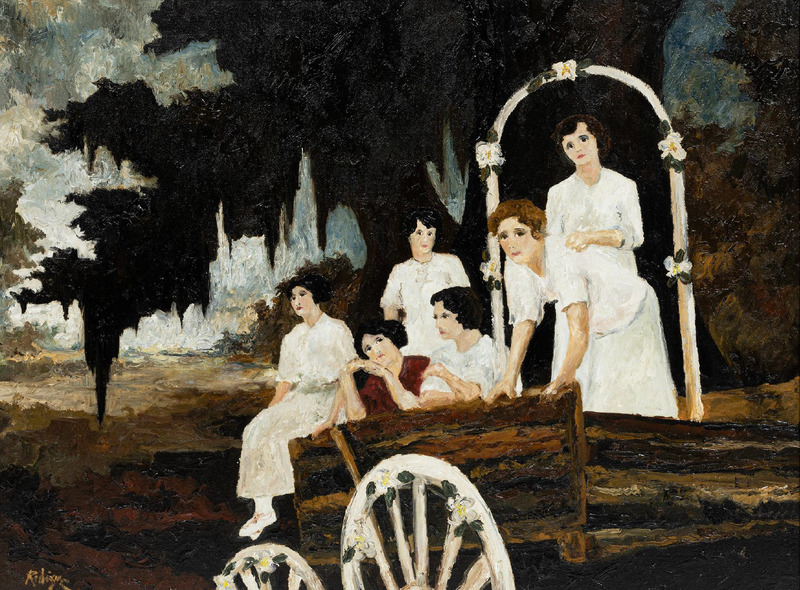
"Queen of the Rice Festival, Crowley, LA"
Rodrigue's depiction of a buggy carrying young teens at the Rice Festival in front of a live oak tree. This painting sold for $54,900.00 in September of 2024. | Source: https://www.nealauction.com/auction-lot/george-rodrigue-queen-of-the-rice-festival-crow_40F4939B4E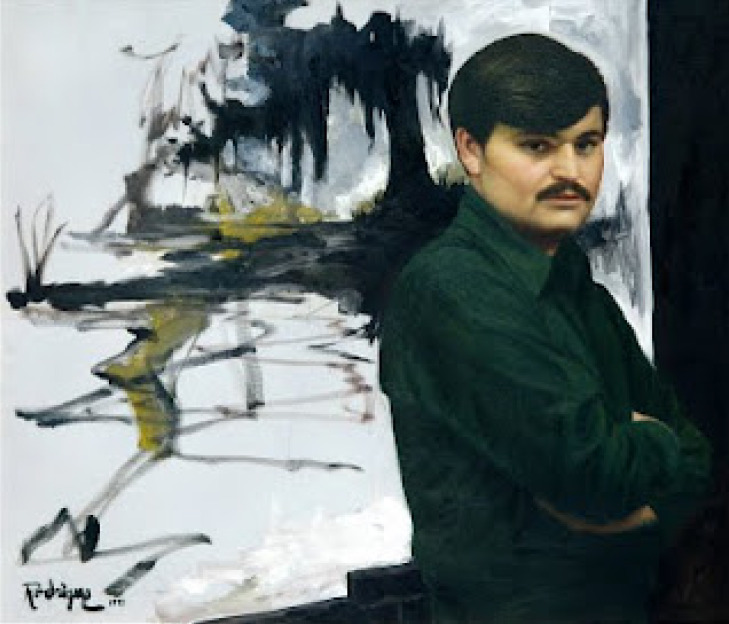
Early Self Portrait
Rodrigue's 1971 self portrait in front of an abstract composition of an oak tree. | Source: https://legacyarttour.org/2009/10/early-oak-trees-and-a-regrettable-self-portrait.html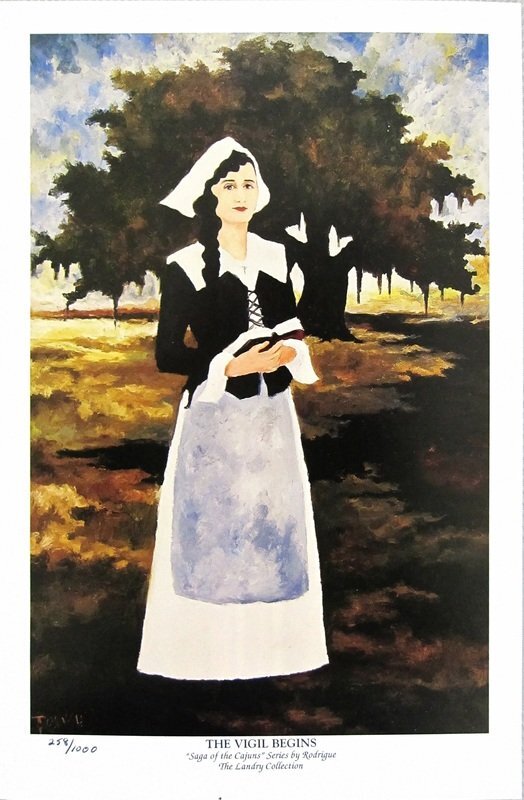
"The Vigil Begins"
Rodrigue's depiction of Evangeline from Longfellow's Epic Poem. Evangeline's story is often viewed as a Cajun mythos and origin story. This painting is part of his "Saga of the Cajun Series, the Landry Collection" | Source: https://barnels.com/product/the-vigil-begins/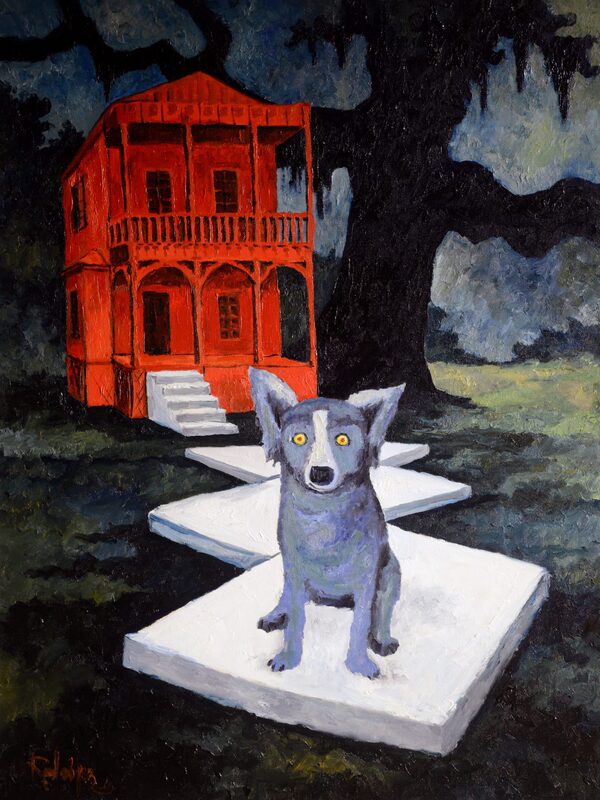
"Watchdog"
Rodrigue's first depiction of the Blue Dog, based off of his dog Tiffany, who is portraying the infamous rougarou of Cajun folklore. | Source: https://ogdenmuseum.org/exhibition/the-first-blue-dog/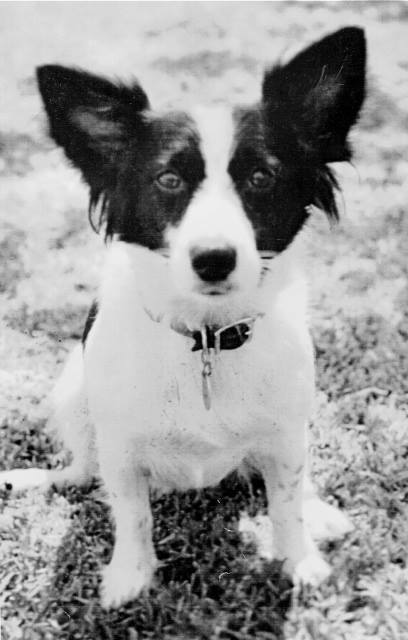
Tiffany
George Rodrigue's model for the Blue Dog | Source: http://georgerodrigue.com/timeline/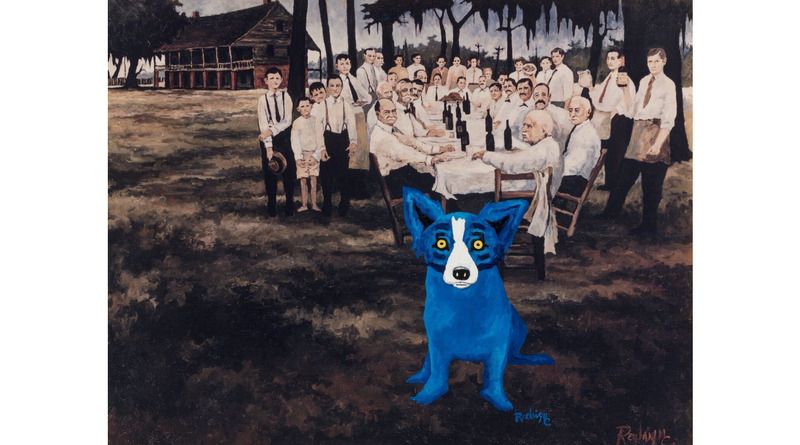
"Eat, Drink, and Forget the Blues"
Rodrigue brings together his "Aioli Dinner" and his "Watchdog," combining his past and future art styles into one Louisiana classic. | Source: https://legacyarttour.org/2009/10/the-aioli-dinner-and-a-cajun-artist.html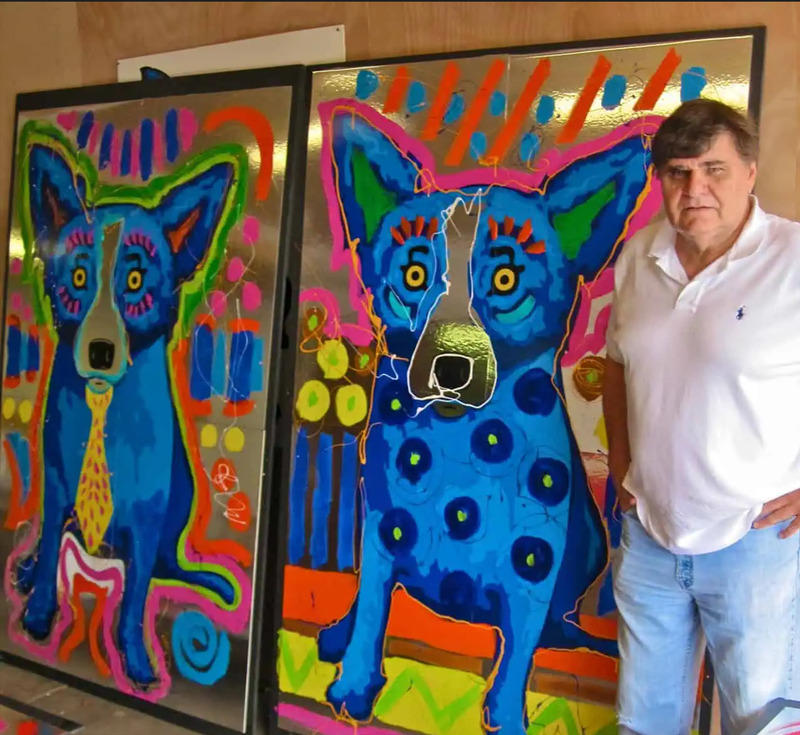
Chasing the Blues Away
Rodrigue poses in front of two Blue Dogs painted on a hospital's glass doors. | Source: https://georgerodrigue.com/blog/rodrigue-shiny-happy-blue-dog/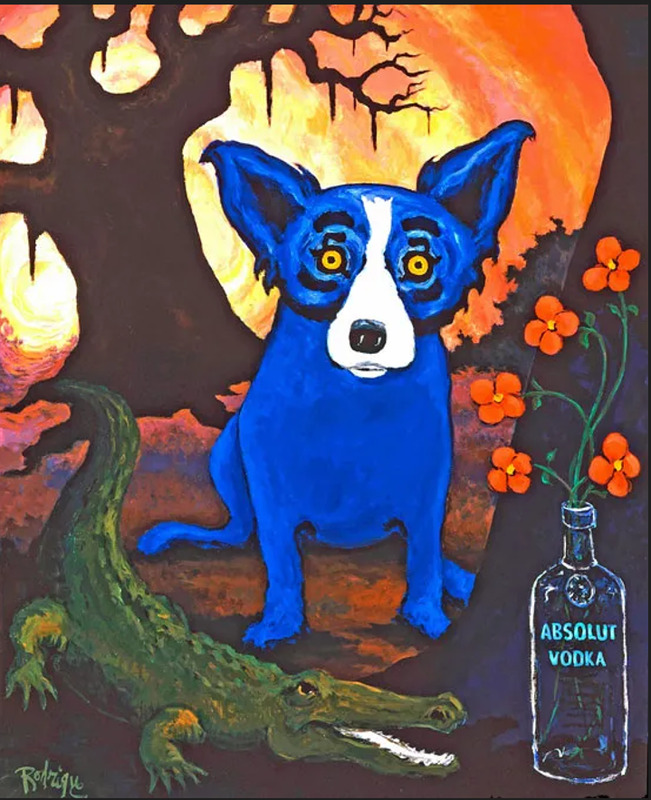
"Absolut Blue Dog"
Blue Dog advertisement for an Absolut Vodka campaign in Louisiana. | Source: https://legacyarttour.org/2013/09/absolut-blue-dog.html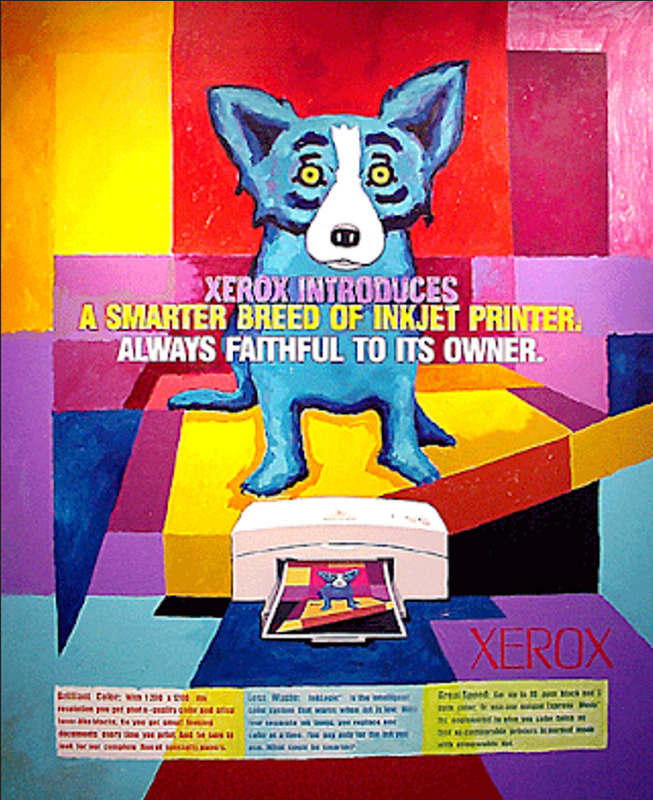
Xerox Blue Dog
Rodrigue's artwork for a Xerox campaign, showcasing the bright colors being introduced by Xerox's upgrade. | Source: https://legacyarttour.org/2010/01/blue-dog-2000-the-year-of-xerox.html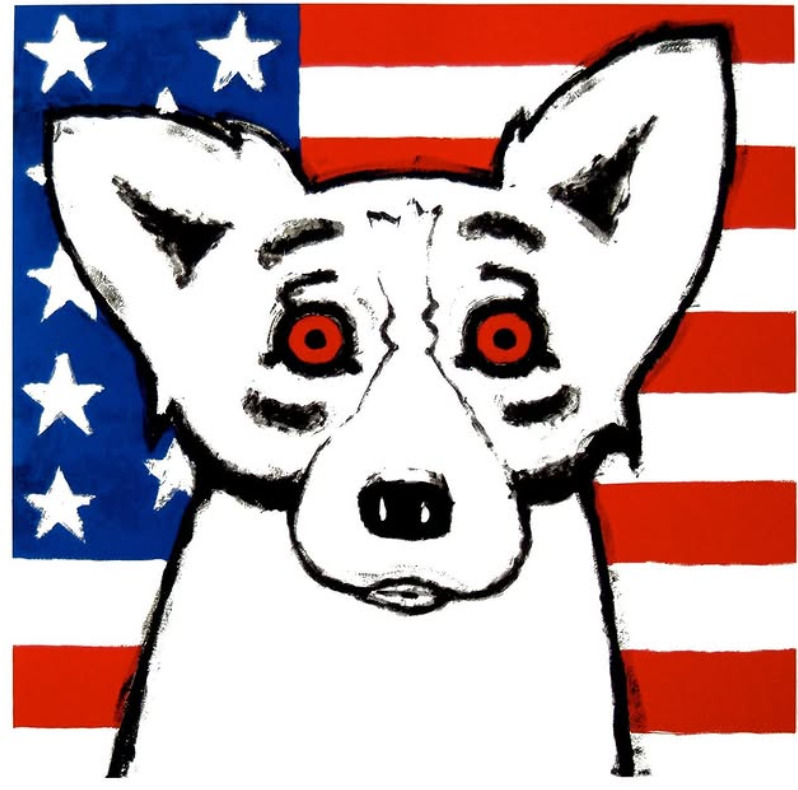
"God Bless America"
Rodrigue's contribution to the patriotic artwork created after 9/11. The Blue Dog's signature yellow eyes are replaced with a mourning stare and bright red eyes in front of an American flag. | Source: https://legacyarttour.org/2010/09/god-bless-america-a-silkscreen-following-9-11-01.html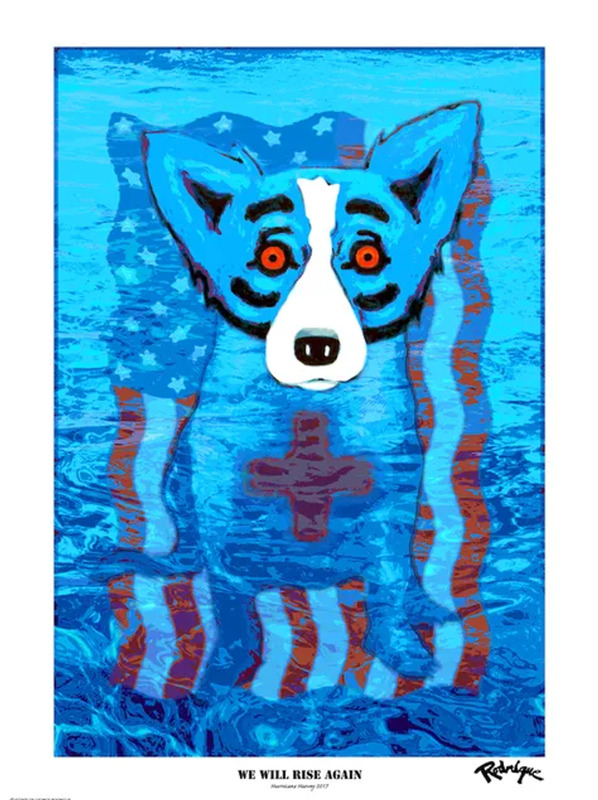
"We Will Rise Again"
Rodrigue's artwork created after Hurricane Katrina to raise money for the New Orleans Museum of Art. The Blue Dog appears once again with red eyes and an American flag, but is submerged in flood waters. | Source: https://geauxart.com/products/we-will-rise-again-blue-dog-by-george-rodrigue-signed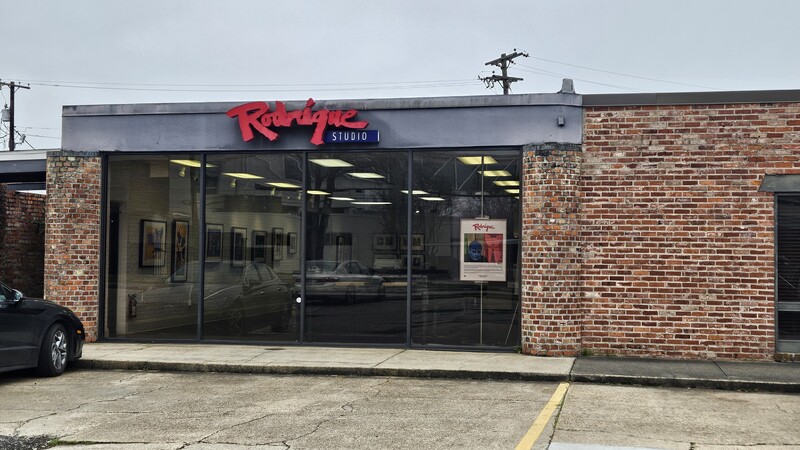
Rodrigue Studios
Rodrigue Studios in Lafayette, Louisiana. Operated by his son. | Source: Author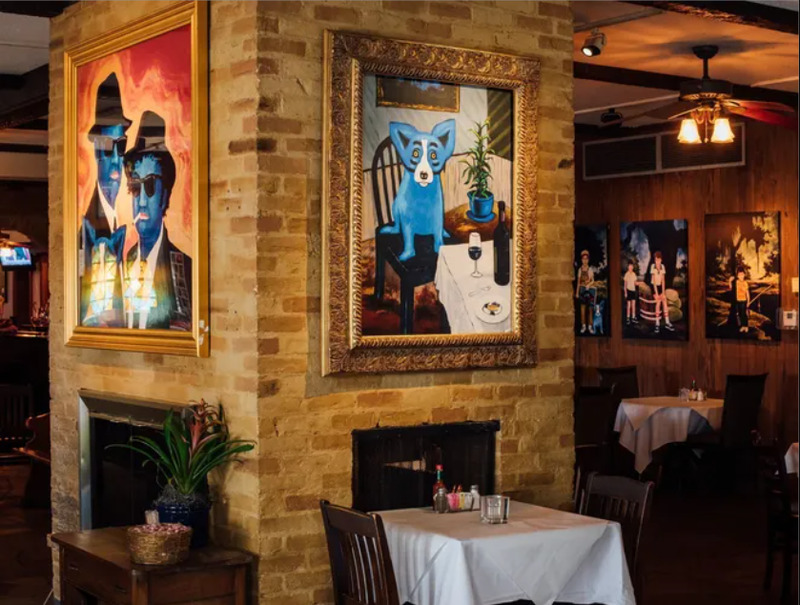
Interior of the Blue Dog Cafe
A photo of the interior of Lafayette's Blue Dog Cafe that shut down shortly after the outbreak of the COVID-19 pandemic. | Source: https://www.onlyinyourstate.com/food/louisiana/the-louisiana-restaurant-thats-one-of-the-most-unique-in-america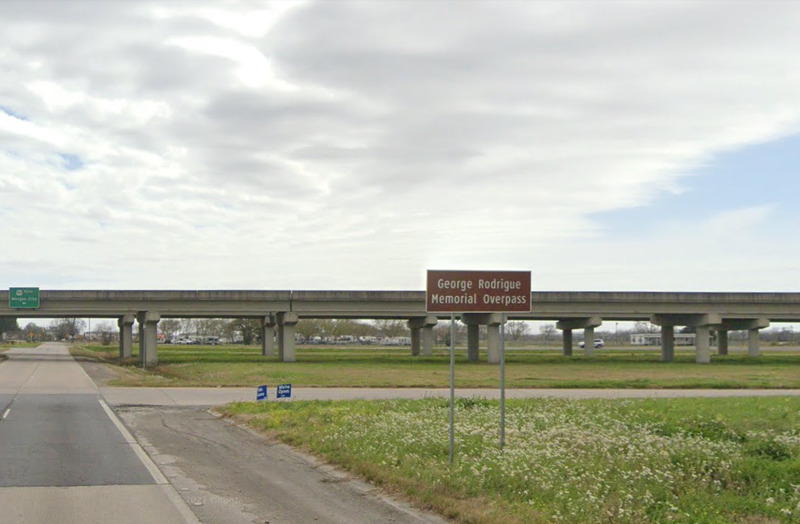
George Rodrigue Overpass Sign
Located at the US Highway 90 and LA Highway 83 Intersection | Source: Google Earth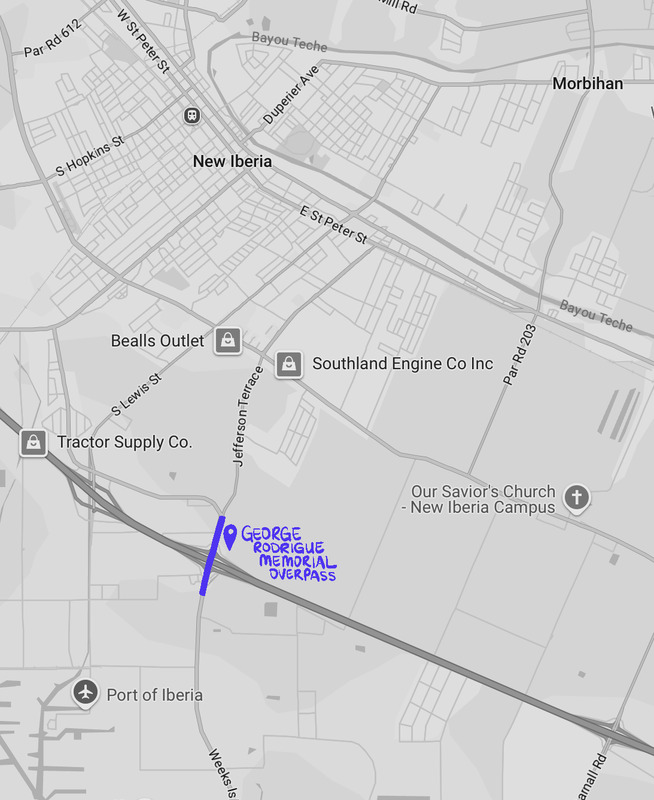
George Rodrigue Memorial Overpass Location
Source: Google Maps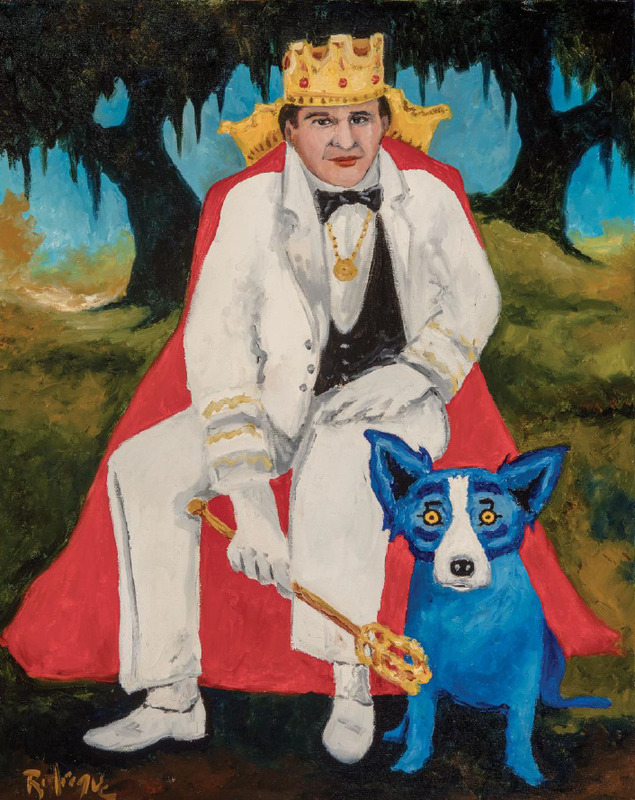
"It's Good to Be King"
A painted self portrait that includes Rodrigue as king, with the Blue Dog by his side and a live oak behind him. | Source: https://www.nealauction.com/auction-lot/george-rodrigue-american-louisiana-1944-2013_3A94542810