Stephen E. Ambrose Memorial Parkway: Founder, Fraud, or Something In-between?
The Stephen E. Ambrose Memorial Parkway is a part of I-10, which was named after a famous American historian who spent most of his career writing about the soldiers who fought in the Second World War, Stephen Ambrose. Ambrose accomplished much during his lifetime and was one of the founders of the National World War II Museum in New Orleans. However, his legacy was tainted when he was accused of a pattern of academic dishonesty in his work. The question now remains: How should he be remembered?
Text
The Stephen E. Ambrose Memorial Parkway is a section of I-10 named after the famed American historian Stephen E. Ambrose, who was one of the founders of the National World War II Museum in New Orleans. However, Ambrose’s legacy is not as pristine as people would like to believe. The discovery of an alleged pattern of academic dishonesty has tarnished his legacy for many. On the extreme ends of the spectrum of opinion, some wish to focus only on the public and academic achievements Ambrose accomplished throughout his career, greatly improving public engagement with American history. While others believe he should be held responsible for his actions, claiming he should not be celebrated as an upstanding academic. Stephen Edward Ambrose was born on January 10th, 1936, as the second son of a U.S. Navy doctor and a housewife. He grew up in Whitewater, Wisconsin, and he, alongside his two brothers, had a comfortable childhood in the small town. However, as he got older, Ambrose felt stifled by his hometown, so when he went to college, he bade farewell to Whitewater and went to the University of Wisconsin at Madison. He began his higher education as a pre-med major, wanting to follow in his father’s footsteps, but that all changed during his sophomore year. After Ambrose took a history elective for his general education, he was inspired by the teaching style of the professor who taught the course and resolved to change his major to pursue history. When he completed his undergraduate, Ambrose moved to Louisiana to pursue his master’s degree at Louisiana State University, and finally, he returned to Wisconsin to complete his PhD. During this time, Ambrose published his first book, which caught the attention of former President Dwight D. Eisenhower. Ambrose worked with Eisenhower on editing the Eisenhower Papers, and Eisenhower also later asked Ambrose to write his biography. Once Ambrose attained his PhD, he was offered a job at the University of New Orleans to teach American history courses. Ambrose accepted and remained at the university for several years. While there, he continued to write and publish books, and most of his works detailed experiences across American history, with a particular focus on the American military. Because of his writing style, Ambrose quickly gained notoriety in the public eye. For the first time in a while, Americans were interested in history and wanted to engage with the stories of the past because Ambrose did not write like a “stuffy” academic—he wrote like a storyteller. Moreover, during his time at UNO, Ambrose befriended a fellow professor in the history department— Dr. Gordon H. “Nick” Mueller. Together, Ambrose and Mueller coordinated several large-scale projects that focused on collecting oral histories from veterans of World War II. In 1991, the duo formed The National D-Day Museum Foundation to begin planning and funding a museum in New Orleans dedicated to the brave soldiers whose stories still needed to be told. In 2000, the museum successfully opened to the public, eventually growing into the National World War II Museum, which now attracts thousands of visitors each year. Ambrose’s meteoric success never seemed to slow down, but that all changed in 2002. In April of that year, Ambrose was diagnosed with terminal lung cancer. About a month later, his reputation suffered a blow, too. A journalist discovered that his recent book, The Wild Blue, contained several sentences and phrases taken from another military historian’s work without the proper citation. Ambrose claimed it was a careless error on his part and fixed it for future editions. However, as more people searched his past work for other instances of these mistakes, a pattern of citation errors began to be uncovered, which traced back to his PhD thesis. Ambrose later succumbed to his lung cancer on October 10th, 2002, in a Bay St. Louis hospital. The namesake of the Stephen E. Ambrose Memorial Parkway was an influential yet flawed figure. He was a man who held a deep love for America’s history, yet he repeatedly made mistakes in his work, bringing his professionalism into question. However, because of his hand in founding the National World War II Museum, Ambrose will continue to be remembered and celebrated, regardless of his repeated citation errors. It falls to historians and the public to acknowledge both Ambrose’s career and missteps to set a better example for future historians.
Files
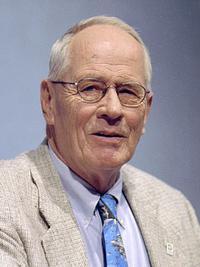
Photo of Stephen E. Ambrose
A photograph of Stephen E. Ambrose later in his life. | Source: https://www.ebsco.com/research-starters/biography/stephen-e-ambrose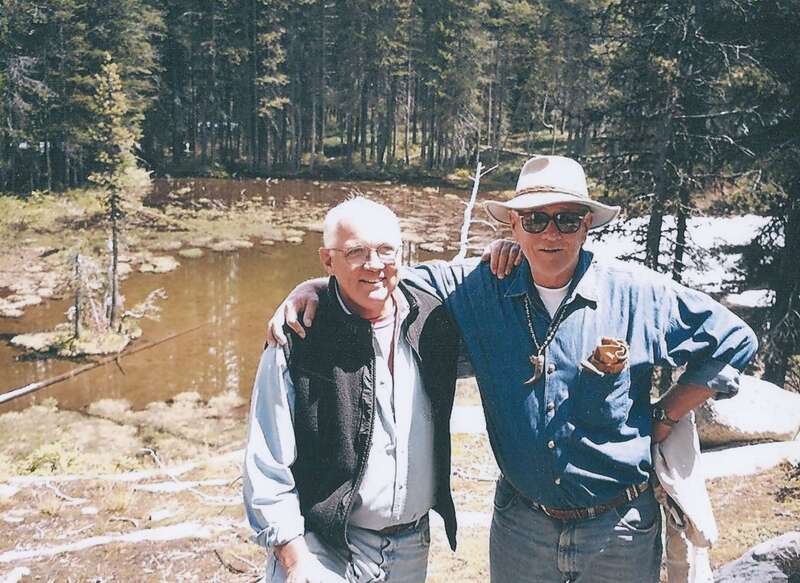
Stephen Ambrose and Nick Mueller
A picture of Ambrose (right) and Mueller (left) while on a hike. Throughout their long-standing friendship, Ambrose, Mueller, and their families went on multiple vacations as one group. | Source: https://www.nationalww2museum.org/about-us/our-team/museum-founders-stephen-ambrose-and-nick-mueller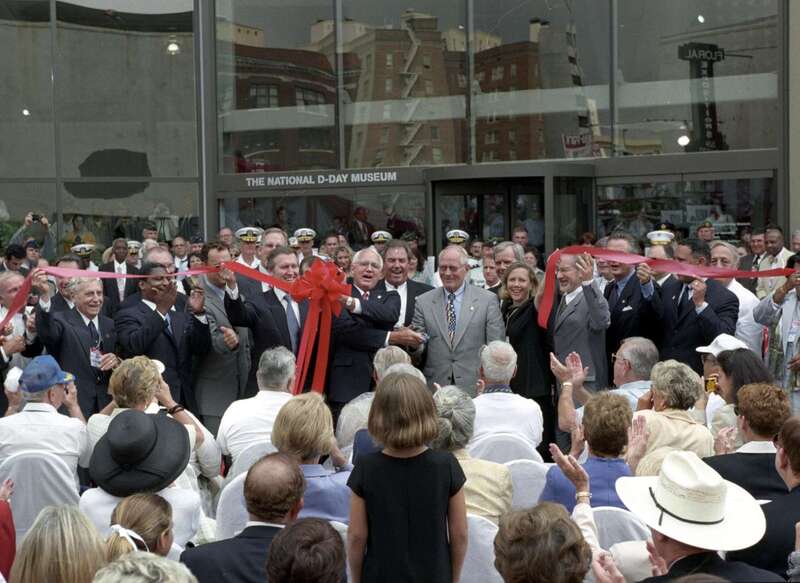
The Opening of the National D-Day Museum
A photo of the moment after Ambrose and Mueller cut the ceremonial ribbon, officially opening the National D-Day Museum in 2000. | Source: https://www.nationalww2museum.org/about-us/our-team/museum-founders-stephen-ambrose-and-nick-mueller | Date: 2000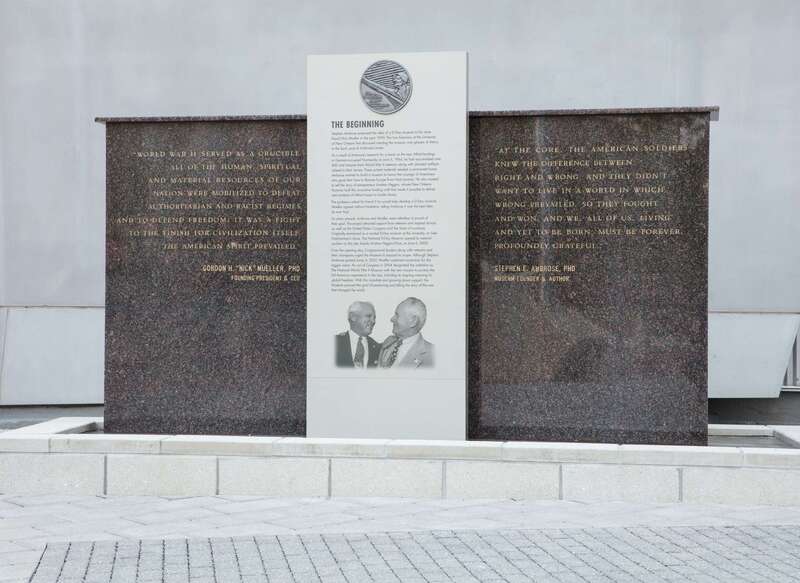
Picture of the Founders Recognition Panel
A photograph of the Founders Recognition panel within the Founders Plaza at the National World War II Museum in New Orleans. The central panel details the story of how the museum was founded, and the outside panels feature quotes from Ambrose and Mueller. | Source: https://www.nationalww2museum.org/visit/museum-campus-guide/founders-plaza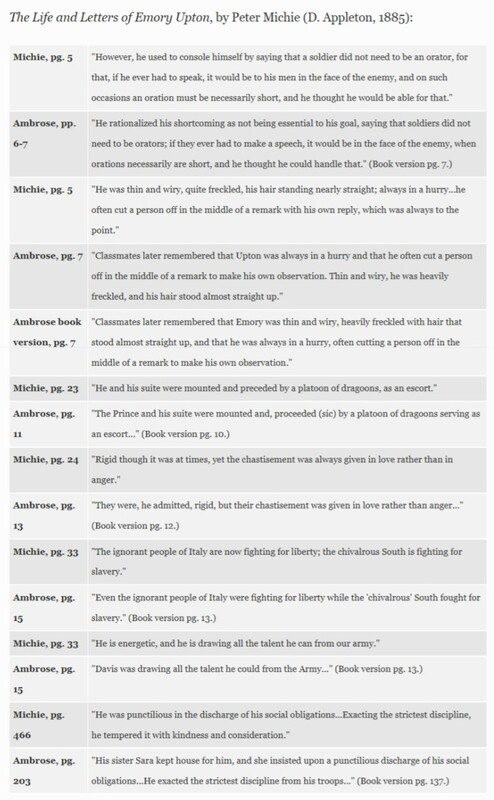
Comparison of Ambrose's PhD Thesis Against One of His Sources
This is a screenshot from Forbes' article about their investigation into Ambrose's alleged plagiarism. This chart compares one of the sources from Ambrose's PhD thesis, The Life and Letters of Emory Upton by Peter Michie, to what Ambrose wrote in the final version of his thesis. | Source: https://www.forbes.com/2002/05/10/0510ambrose.html | Date: May 10, 2002